
01 — Context
14
70–93%
95%+
Scores are generated monthly. An auditor cross-references calendar events against manual notes, looking for evidence that responsibility changed hands.
That wasn't a design gap. It was a clinical risk.


02 — System design


03 — The hard problem
My co-founder's original model was built around handovers. Designing the actual flow revealed a structural failure, so I proposed a different model entirely.

System map — role, responsibility, and machine state modelled as one connected system

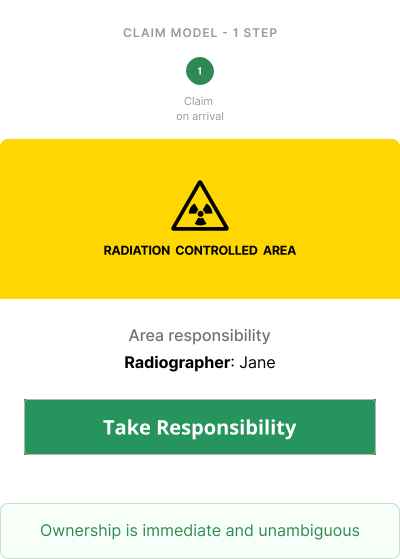
Responsibility is no longer transferred.
It is claimed in real time.
The founder's model made sense conceptually — one person hands over to another. But when I started designing the actual flow in software, the problem became clear: what happens when the receiving person doesn't accept? You get a blocked state with no owner. That's when I went back to the physical board and noticed people were already claiming responsibility themselves on arrival. The software model needed to match that behaviour — not the conceptual one.
04 — Iterations
Before landing on the final flow, I tested three ownership models — each revealing a different failure mode until the claim-based approach resolved them all.
Shift
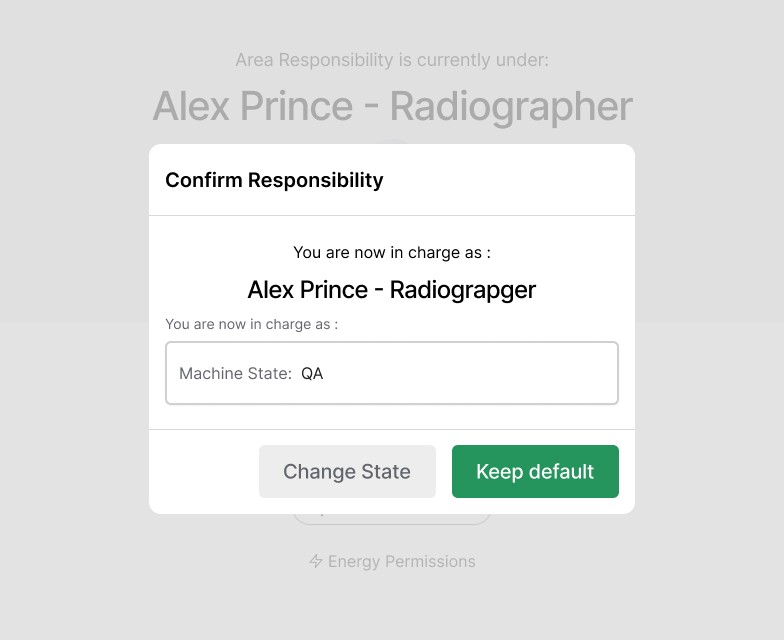
This eliminated handover as a failure point in a safety-critical system.

Final
Clear ownership + simplified flow while maintaining safety.



05 — Output
The same underlying model surfaces differently depending on context and user need.
TAblet
Real-time operation
- Claim area responsibility
- Update machine state
- PIN-verified actions
WebApp - Admin
System governance
- Live monitor across all linacs
- Role and permissions config
- State timeline + audit log


06 — Results
No live metrics yet — the system is in its first hospital integration. Success was defined before a single screen was built. Target: 95%+ compliance across all 14 centres, measured at 3 and 6 months.
Two hospital pilots launching.
01
Responsibility always owned
Any authorised person can identify who is responsible for a given area at any moment. No verbal communication, no manual records required. Replaces a system scoring 70–93% compliance.
02
Full audit trail, automatically
Compliance teams can reconstruct the complete responsibility and machine state history of any area, for any time period. No manual documentation needed. Replaces manual spreadsheet entry.
03
Transitions match real behaviour
Staff complete responsibility transitions without friction. The flow mirrors how people already acted at the physical board.
04
Operational analytics, for the first time
Machine state data is captured continuously across all linacs. No baseline exists to compare against — this capability didn't exist before. Enables departments to identify patterns in machine usage, downtime, and shift coverage over time.