Designing a multi-role system for Radiation Safety & Responsibility in Radiotherapy
Designing a multi-role system for Radiation Safety & Responsibility in Radiotherapy
Designing a multi-role system for Radiation Safety & Responsibility in Radiotherapy
Defining how responsibility moves across roles and how machine state is tracked in Radiation Controlled Areas
Defining how responsibility moves across roles and how machine state is tracked in Radiation Controlled Areas
Defining how responsibility moves across roles and how machine state is tracked in Radiation Controlled Areas

Problem Framing
Problem Framing
Problem Framing
Radiotherapy workflows rely on coordination between Radiographers, Physicists, and Engineers, but responsibility is often informal, unclear, and not tracked. This creates critical risks:
• Unclear ownership of machine state
• No reliable audit trail
• Breakdowns during handovers
There was no formal system. Responsibility and machine state were tracked manually, often inconsistently.
Radiotherapy workflows rely on coordination between Radiographers, Physicists, and Engineers, but responsibility is often informal, unclear, and not tracked. This creates critical risks:
• Unclear ownership of machine state
• No reliable audit trail
• Breakdowns during handovers
There was no formal system. Responsibility and machine state were tracked manually, often inconsistently.
My Role
My Role
Founding Product Designer (0→1)
Defined:
• Responsibility model across roles
• System logic linking ownership + machine state
• Interaction model across tablet (real-time) and admin (oversight)
Founding Product Designer (0→1)
Defined:
• Responsibility model across roles
• System logic linking ownership + machine state
• Interaction model across tablet (real-time) and admin (oversight)
Challenge:
• Make responsibility explicit across roles
• Track machine state reliably for safety and compliance
• Make responsibility explicit across roles
• Track machine state reliably for safety and compliance
System requirements:
• One clear owner at all times
• Machine state reflects real-world use
• All transitions are traceable
• One clear owner at all times
• Machine state reflects real-world use
• All transitions are traceable


Defining the system
Defining the system
Defining the system
There was no formal model linking roles, responsibility, and machine state. This logic existed only in manual workflows.
To make it explicit, I mapped how responsibility, roles, and machine state interact as one system.
There was no formal model linking roles, responsibility, and machine state. This logic existed only in manual workflows.
To make it explicit, I mapped how responsibility, roles, and machine state interact as one system.

Where the model breaks in practice
Where the model breaks in practice
Where the model breaks in practice
In practice, responsibility is passed manually between roles, creating gaps in ownership and traceability.
Responsibility breaks during handovers
Ownership becomes unclear during handovers
Transitions introduce delays in critical workflows
System state and responsibility fall out of sync
Roles and machine state were tightly coupled, but managed separately, leading to inconsistencies in both.

Key shift
Key shift
Key shift
From
responsibility is handed over →
responsibility is handed over —→
To
responsibility is claimed
Responsibility is no longer handed over. It is claimed in real time, directly linking ownership to machine state.
Responsibility is no longer handed over. It is claimed in real time, directly linking ownership to machine state.
Testing the model
Testing the model
Testing the model
Tested:
Handover model → created blocked states when responsibility wasn’t accepted
Pending ownership → introduced delays and friction
Self-claim model → simplified workflows and reduced risk

This model redefined responsibility as a real-time action, not a transfer. It removed handover dependency, reducing delays and improving traceability.
This model redefined responsibility as a real-time action, not a transfer. It removed handover dependency, reducing delays and improving traceability.
The next step was designing how this system surfaces across two interfaces.
The next step was designing how this system surfaces across two interfaces.
One system, Two interfaces
One system, Two interfaces
One system, Two interfaces
Clarifies ownership, reduces delays, and enables safe, auditable workflows across roles.
Clarifies ownership, reduces delays, and enables safe, auditable workflows across roles.
• Tablet → real-time actions in high-pressure clinical environments
• Admin → system-wide control, configuration, and auditability
• Tablet → real-time actions in high-pressure clinical environments
• Admin → system-wide control, configuration, and auditability
Same system. Different surfaces.
Same system. Different surfaces.
Admin → System Control
• Configure roles and permissions
• Monitor machine states across areas
• Maintain audit logs for compliance
Tablet → Real-Time Operation
• Take responsibility for areas
• Update machine state in real time
• Perform actions on-site
Eliminating Handover: Designing for Ownership
Eliminating Handover: Designing for Ownership
Eliminating Handover: Designing for Ownership
Tested different models to define how responsibility should work in practice.
1
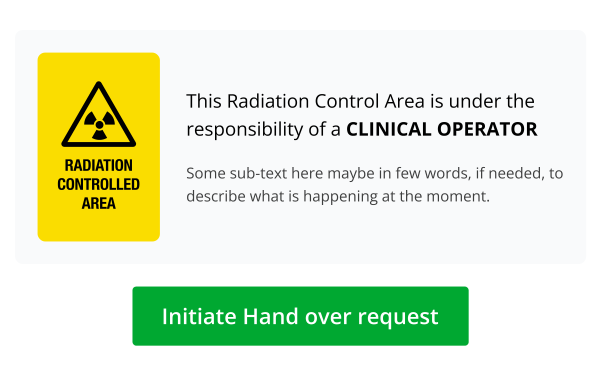
Push Model
Initial workflows relied on handovers between roles.
This created blocked states, unclear ownership, and delays in high-risk environments which someone intiated a Hand over request…
2
Risk
Pending states blocked workflows and delayed actions.

3
Shift
This eliminated handover as a failure point in a safety-critical system.

4
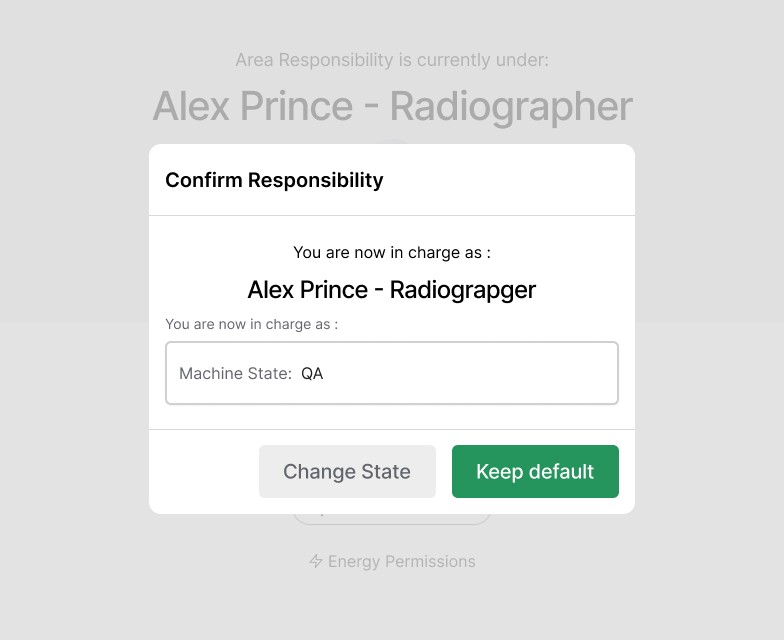
Final
Clear ownership + simplified flow while maintaining safety.



Admin → System Governance
Admin → System Governance
Admin → System Governance
Ensures system-wide control, visibility, and compliance.
Ensures system-wide control, visibility, and compliance.
The admin system was structured across 4 core areas:
The admin system was structured across 4 core areas:
• Monitoring → real-time visibility across machines and locations
• Configuration → roles, permissions, and system rules
• Audit & Logs → traceability of actions and responsibility
• Data & Reporting → operational insights and system usage
• Monitoring → real-time visibility across machines and locations
• Configuration → roles, permissions, and system rules
• Audit & Logs → traceability of actions and responsibility
• Data & Reporting → operational insights and system usage
System Monitoring — Real-Time Machine Status
System Monitoring — Real-Time Machine Status
Provides a live overview of machine states, responsibility, and operational status across locations.
Provides a live overview of machine states, responsibility, and operational status across locations.

Operations Dashboard — Activity & Performance Trends
Operations Dashboard — Activity & Performance Trends
Surfaces usage patterns, anomalies, and system activity to support operational decision-making.
Surfaces usage patterns, anomalies, and system activity to support operational decision-making.

Audit / Timeline
Audit / Timeline
Tracks all state changes and responsibility transitions for full traceability and compliance.
Tracks all state changes and responsibility transitions for full traceability and compliance.

System Configuration — Machine Types & States
System Configuration — Machine Types & States
Defines operational states and rules that govern how machines behave across the system.
Defines operational states and rules that govern how machines behave across the system.

Device Management — Tablet Configuration
Device Management — Tablet Configuration
Manages connected devices and ensures consistent setup across clinical environments.
Manages connected devices and ensures consistent setup across clinical environments.

Impact
Impact
Operational impact
Operational impact
• Removed dependency on handovers → reduced risk of stalled workflows
• Made ownership explicit → improved accountability in clinical environments
• Removed dependency on handovers → reduced risk of stalled workflows
• Made ownership explicit → improved accountability in clinical environments
System impact
System impact
• Unified responsibility and machine state into a single model
• Enabled consistent behaviour across tablet and admin interfaces
• Unified responsibility and machine state into a single model
• Enabled consistent behaviour across tablet and admin interfaces
Expected impact
Expected impact
Expected to:
• Reduce delays in machine state transitions
• Improve auditability for compliance
• Support safer decision-making in high-risk environments
Expected to:
• Reduce delays in machine state transitions
• Improve auditability for compliance
• Support safer decision-making in high-risk environments